
An afternoon with Aston Martin Singapore at Raffles Sentosa is the sort of invitation that makes even seasoned owners sit up a little straighter.

Under a canopy of palms and soft island light, distinguished guests were treated to a masterclass in what makes an Aston Martin feel so effortlessly right.
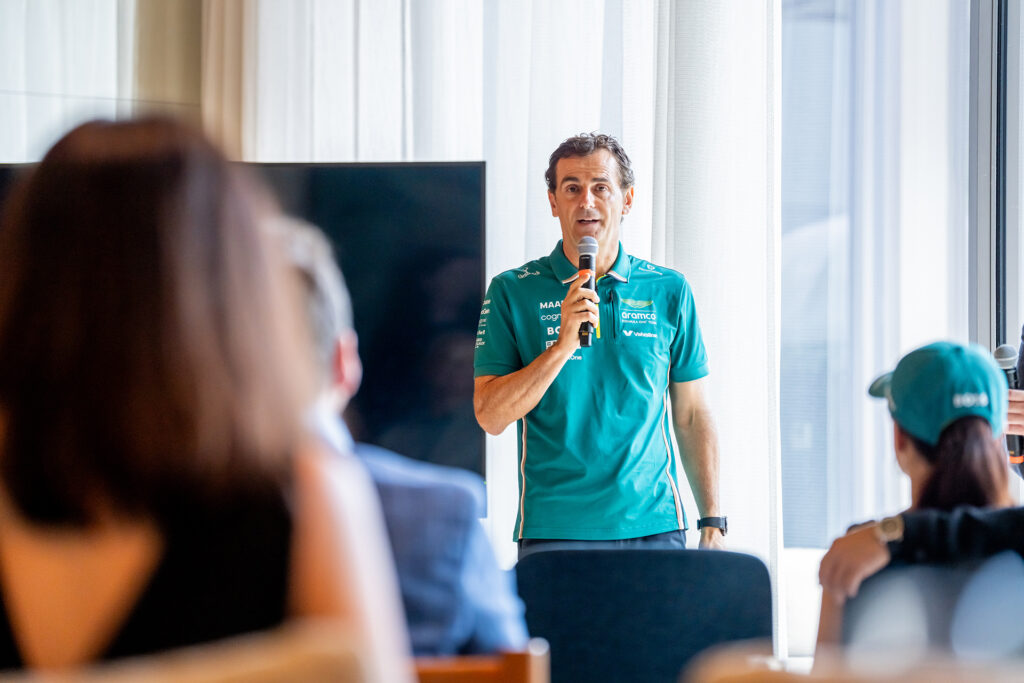
The afternoon kicked off with a sharing session by newly minted Aston Martin Aramco Formula 1 Global Ambassador Pedro de la Rosa. After stepping away from the Formula 1 grid for over a decade, he now continues to share his passion for performance, notably by giving VIP guests unforgettable hot laps in the Aston Martin DBX and Vantage on some of the world’s most iconic circuits.
Drawing from years of experience at the pinnacle of motorsport, his driving philosophy is rooted in precision and intuition. Pedro describes the dialogue between man and machine as something deeply sensory: translating micro-feelings from the cockpit into insights that designers and engineers can build upon.
As he puts it, “A design brief is a living document, shaped by what the car must communicate through the wheel, whether at 50 km/h or 150 km/h.” In his view, a car’s form is not just to be admired, but to be read.
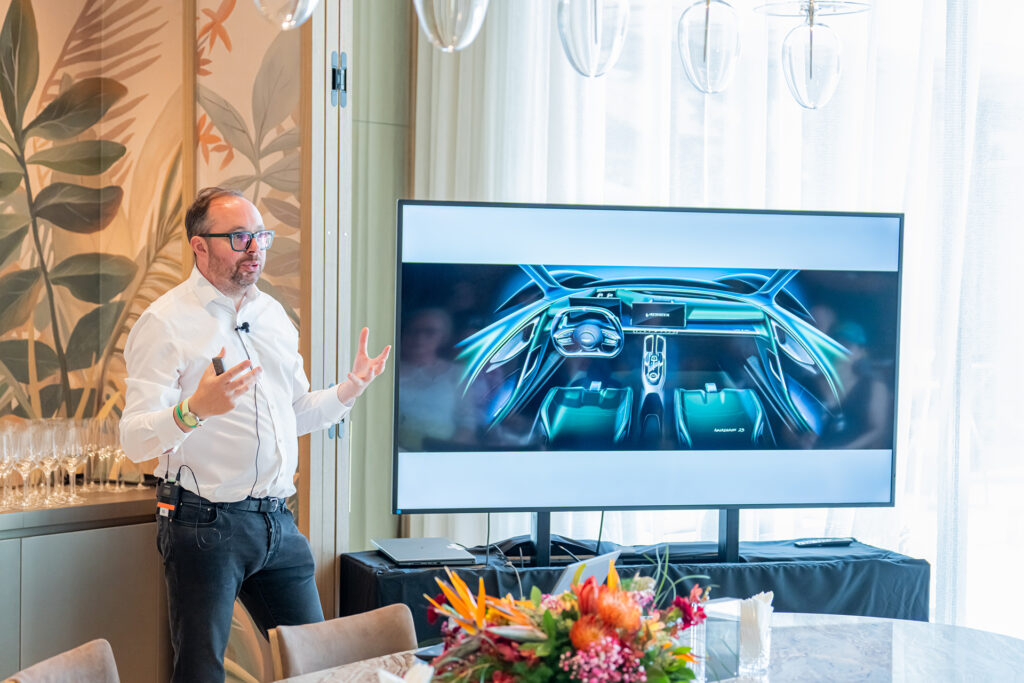
And no one reads a car’s facade better than Miles Nürnberger, whose session slipped the velvet rope on Aston Martin’s creative process.
How do new Astons come to life? Think of it as a three-act ballet.
Act I: Intent
Proportion is king here. Designers start with the “golden lines”: wheelbase, dash-to-axle, cabin set-back and those unmistakable haunches. The grille silhouette, the side strake, the light catchers along the flanks are all coded with the brand’s DNA.
Early work alternates between pencil sketches and rapid digital clay, defining stance and mass. The aim is to make the car look fast while parked, balanced while moving, and unmistakably Aston from twenty paces.
If you covered the badge, would you still know that’s an Aston Martin? That’s the bar.
Act II: Dialogue

Aerodynamics and design don’t sit at opposite ends of a conference table at Aston Martin; they share a sketchbook. Surfaces are pulled taut where the air wants to cling, relaxed where it should detach.
In practice, that means endless loops between the studio’s clay model and CFD (computational fluid dynamics) rigs, punctuated by wind-tunnel sessions and back again. When the aero team asks for a sharper trailing edge, design counters with a millimetre here, a fraction of a degree there, preserving sculpture while unlocking downforce or reducing drag.
Miles’ sharing on the Valhalla’s extensive design work exemplifies this: mid-engined proportions, airflow management through and over the body, and active devices that tuck away out of sight.
Is it art serving science or science serving art? At Aston, it’s a duet.
Act III: Truth
Full-scale clay becomes “hard model”, then mule, then prototype. CMF (colour, materials and finish) joins the conversation early, because tactility is not an afterthought at Aston. You’ll hear talk of open-pore veneers versus high-gloss, anodised knurled metals that feel cool to the touch, leathers chosen not only for grain but for how they patinate with time.
Ergonomics gets its own laboratory, ensuring everything from H-points, sightlines, pedal spacing, and even the reach to rotary controllers are all comfortable touchpoints. Virtual reality reviews are used to spot a problem before a tool is cut, then comes supplier feasibility and tolerances measured like watchmaking.
Finally, the car is put through its paces through a dynamic sign-off. Through this, quiet calibrations are tweaked until the car speaks fluent Aston.

The afternoon closed on an unexpected yet on-brand note: a showcase with Elemis, Aston Martin’s new official skincare partner.
At first blush, fast cars and skincare might seem odd bedfellows. However, look closer and the alignment is sensible. In the same way a race car’s set-up is honed for conditions, a high-performance regimen is optimised for stress, travel and time. Different playbook, similar philosophy.

An Aston Martin wears its elegance lightly, but the journey from idea to icon is anything but casual. It’s the art of speed practised with the discipline of engineering, the confidence of heritage and the humility to keep listening: to air, to road, to driver.
After all, a beautiful car that doesn’t move you is an ornament. An Aston Martin is a conversation in metal, and on this peaceful afternoon, the dialogue was crystal clear.
Read more Aston Martin content, right here on Burnpavement.